

Characterizing Geopolitical Relationships to Better Understand Trade
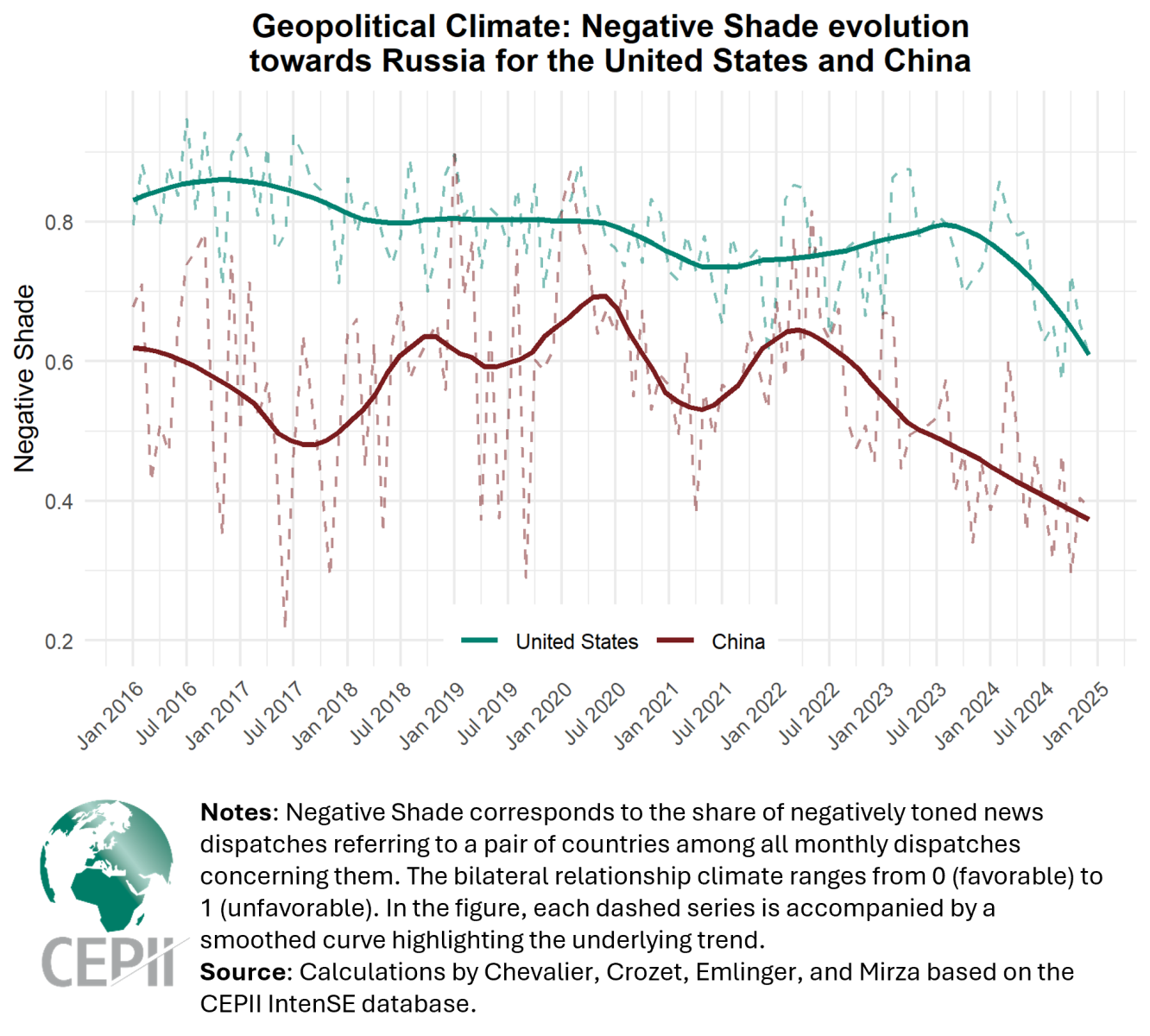
The markedly negative tone of relations with Russia has eased for the American and Chinese superpowers, according to the geopolitical climate indicator “Shade."
By Nathan Chevalier, Matthieu Crozet, Charlotte Emlinger, Daniel Mirza
 Post
PostThe new IntenSE (Intensity and Shade of Events) database developed by CEPII draws on news agency dispatches from the GDELT database to construct the “Shade” indicator, which captures the negative tone of the geopolitical climate at the level of bilateral relations among 201 countries since 2016, on a monthly basis.
Among these, the U.S.–Russia relationship, characterized by a strongly negative and stable tone since 2016, has improved significantly starting in 2024, in the context of the campaign and subsequent re-election of Donald Trump to the White House.
To a lesser extent, the negative tone of the China–Russia relationship fluctuated until the invasion of Ukraine in February 2022. Its steady decline since then reflects a rapprochement between the two major neighbors.
Econometric analysis of these data reveals a high sensitivity of international trade to changes in the geopolitical climate. Low-intensity, non-violent events can lead to persistent contractions in trade flows, with effects comparable in magnitude to those of armed conflicts.
To go further, read, Avis de tempêtes : l’ombre des tensions géopolitiques sur le commerce international and Trade under Tensions: Insights from Media-Reported Bilateral Events.
Among these, the U.S.–Russia relationship, characterized by a strongly negative and stable tone since 2016, has improved significantly starting in 2024, in the context of the campaign and subsequent re-election of Donald Trump to the White House.
To a lesser extent, the negative tone of the China–Russia relationship fluctuated until the invasion of Ukraine in February 2022. Its steady decline since then reflects a rapprochement between the two major neighbors.
Econometric analysis of these data reveals a high sensitivity of international trade to changes in the geopolitical climate. Low-intensity, non-violent events can lead to persistent contractions in trade flows, with effects comparable in magnitude to those of armed conflicts.
To go further, read, Avis de tempêtes : l’ombre des tensions géopolitiques sur le commerce international and Trade under Tensions: Insights from Media-Reported Bilateral Events.
< Back